An Overview of Matarbari Deep-Sea Port

Located in the Matarbari area of Cox’s Bazar District, Chittagong Division, Bangladesh (Coordinates: 21.67°N 91.95°E), the Matarbari Deep-Sea Port is evolving from a coal-loading jetty for the Moheshkhali power plant into the country’s first fully-fledged deep-sea port. This transformative infrastructure project aims to overcome the draft limitations of Chittagong and Mongla ports, positioning Bangladesh as a pivotal maritime hub in the Bay of Bengal region.

Harbour and Channel Specifications
  • Artificial Harbour: The port features a man-made harbor with robust breakwaters, boasting a depth of 16 meters (up to 18 meters with tidal support). This allows it to accommodate Panamax and Capesize vessels, with capacities of up to 8,000 TEUs or 100,000 DWT.
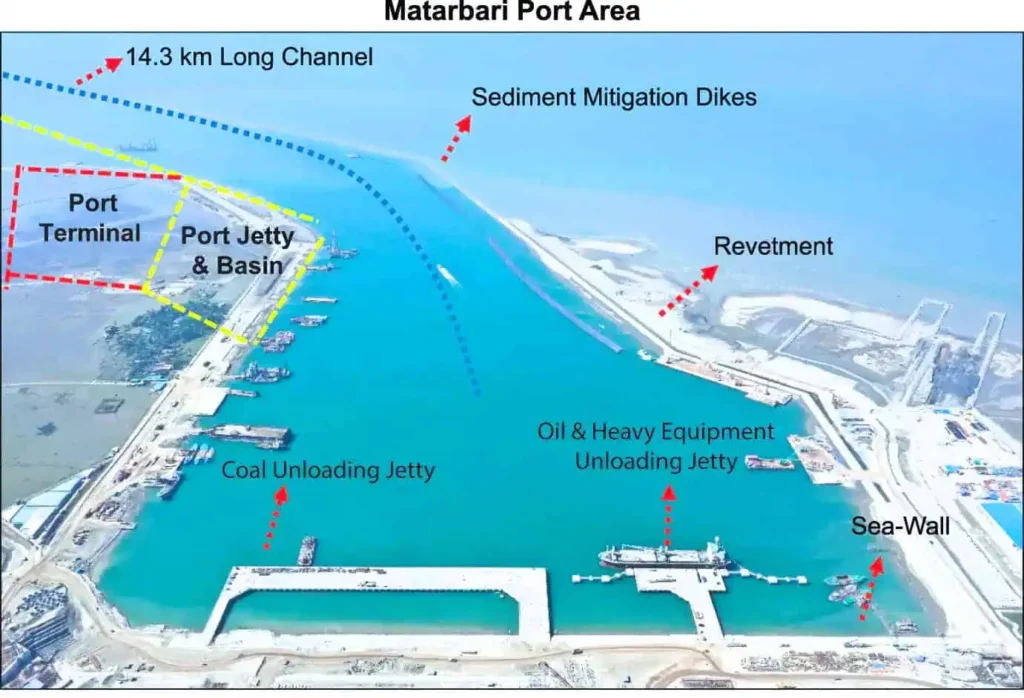
  • Navigational Channel: Stretching 14.3 km long and 350 meters wide, this channel—handed over to the Chittagong Port Authority (CPA) on September 20, 2023—is the deepest among Bangladesh’s ports. It ensures efficient vessel movement, reducing congestion and turnaround times.
  • Comparison to Existing Ports: Chittagong and Mongla ports are limited to drafts of 9.5 meters, capping vessel sizes at 2,400 TEUs. Matarbari’s deeper draft addresses this bottleneck, enabling direct docking of mother vessels.
Key Features and Developments
  • Deep-Water Access: With a draft of 16-18 meters, the port supports vessels carrying over 8,000 containers, significantly enhancing cargo handling capacity and reducing reliance on transshipment hubs like Colombo and Singapore.
  • Channel Construction: Funded and built by the Japan International Cooperation Agency (JICA), the 14.3 km channel is operational for limited use (e.g., coal shipments) and supports the port’s expansion into a commercial facility.
  • Infrastructure:
    • A 100-meter jetty was planned alongside the channel and approved by the National Economic Council Executive Committee (ECNEC) on March 10, 2020. However, current plans prioritize a 460-meter container jetty and a 300-meter multipurpose jetty, with construction set to begin following contractor finalization in late 2023.
    • Container yards and modern facilities are under development to expedite cargo handling.
  • Timeline Updates:
    • Coal Terminal: Originally slated for August 2022, it has been operational since at least April 2023, handling vessels like the 230-meter Ausu Maro (80,000 metric tons of coal).
    • Multipurpose and Container Terminals: Earlier projections of November 2026 have been revised; the first phase is now expected to be fully operational by December 2029, per Brig Gen (retd) M Shakhawat Hussain’s October 2024 statement (Maritime Gateway, October 22, 2024). Commercial operations with mother vessels are anticipated to start in 2030.

Matarbari Port Area

Preliminary Construction Plans
  • Phase One:
    • The project includes a general cargo terminal and a container terminal designed for large vessels unable to dock at existing Bangladeshi ports.
    • The container terminal (18 hectares, 460-meter berth) targets an annual capacity of 600,000 to 1.1 million TEUs, scalable to 1.4 to 4.2 million TEUs by 2041.
  • Current Status: The navigational channel is complete, and terminal construction is imminent. Following JICA and government approvals, a Japanese joint venture is poised to lead construction.
Economic and Strategic Impact
  • Regional Hub: Positioned 34 nautical miles from Chittagong, 190 from Payra, and 240 from Mongla, Matarbari is set to serve 3 billion people across Bangladesh, Northeast India, Nepal, and Bhutan, acting as a transshipment hub in the Bay of Bengal.
  • Economic Boost: Expected to contribute 2-3% to Bangladesh’s GDP and create up to 900,000 jobs, the port will enhance trade efficiency, cutting export times to the US from 45 days to 23 days and saving $131 per 20-foot container and $197 per 40-foot container compared to Chittagong (JICA estimates).
  • Funding: The $1.5 billion project (Tk 17,777 crore) is backed by JICA ($1.09 billion loan), with additional contributions from the Bangladesh government and CPA. An extra Tk 6,573.96 million was approved in 2024 to address cost revisions.
  • Geopolitical Context: Japan and India’s support counters earlier Chinese interest (e.g., the scrapped Sonadia project), aligning with the Indo-Pacific maritime corridor vision.
Latest Information for Maritime Stakeholders (March 22, 2025)
  • Operational Use: Since 2023, the port has handled 112 cargo ships, primarily coal, generating Tk6.84 crore in revenue, proving its capacity for large vessels.
  • Connectivity: A 27 km access road to Fasiakhali, linking to the Chittagong-Cox’s Bazar highway, is under construction (target: December 2026), enhancing inland logistics. Plans are underway for future rail connectivity and potential river transport integration to facilitate smoother cargo movement.
  • Agency Support: Local firms like Chittagong Port Agent are gearing up to provide protective agency, husbandry, and charterer services once commercial operations expand.
  • Challenges:
    • Delays to 2029 may impact planning for stakeholders expecting earlier access.
    • Existing logistics may constrain efficiency until complete infrastructure (e.g., roads, terminals) is completed.
Actionable Insights for Stakeholders
  • Ship Owners/Managers: Leverage the coal terminal for bulk shipments (e.g., 80,000 DWT vessels) and prepare for 8,000+ TEU container operations post-2029, reducing feeder vessel dependency.
  • Charterers: Plan for higher cargo volumes per trip with direct routes, enhancing voyage flexibility by 2030.
  • Cargo Brokers: Emphasize cost savings ($131-$197 per container) and faster client transit times, with multipurpose berths supporting diverse cargo (e.g., steel, LNG, clinker).
  • Port Competitors: Colombo and Singapore may see reduced Bangladesh transshipment demand as Matarbari scales up.
Inland Connectivity Details
  • Road Network: The ongoing construction of the 27 km access road to Fasiakhali, connecting to the Chittagong-Cox’s Bazar highway, is a crucial component of the port’s inland connectivity. This road will facilitate the efficient cargo movement to and from the port.
  • Rail Connectivity: Plans are in place to establish a dedicated rail freight terminal within the port area. This terminal will link the port to the national railway network, enabling the transportation of large volumes of cargo via rail, reducing road congestion, and lowering transportation costs.
  • River Transport Integration: The port’s master plan includes provisions for potential integration with river transport networks. This will allow inland waterways to transport cargo, particularly bulk materials, to and from the port, further enhancing connectivity and reducing reliance on road transport.
  • Logistics Parks and Industrial Zones: The development of logistics parks and industrial zones in the surrounding areas is planned to create a comprehensive maritime and industrial hub. These zones will be strategically located to facilitate seamless cargo movement and value-added processing.
  • Multimodal Transport Hub: Matarbari Port’s long-term vision includes developing a multimodal transport hub integrating road, rail, and river transport to provide efficient and cost-effective cargo movement solutions.
Terminal Specifications (Preliminary)
  • Container Terminal: Designed for 8,000+ TEU vessels, with advanced gantry cranes and automated systems to optimize cargo handling.
  • Multipurpose Terminal: Equipped to handle a variety of cargo, including bulk materials, project cargo, and general goods, with flexible berthing arrangements.
  • General Cargo Terminal: This terminal is intended to handle non-containerized cargo and will support importing and exporting a wide range of goods.
Future Expansion Phases
Phase Two and Beyond

The primary focus of future expansion phases will be to increase the port’s annual handling capacity to 4.2 million TEUs by 2041. This will involve:

  • Construction of additional containers and multipurpose berths.
  • Expansion of container yards and storage facilities.
  • Development of advanced cargo handling equipment and automation systems.
  • Enhancement of inland logistics infrastructure, including road and rail connectivity.
Specialized Terminals

Long-term plans include the development of specialized terminals to handle specific cargo types, such as:

  • LNG (Liquefied Natural Gas) terminals to support Bangladesh’s growing energy needs.
  • Petrochemical terminals for the import and export of chemical products.
  • Bulk cargo terminals for handling coal, cement, and other bulk materials.
Industrial and Logistics Hub

The port’s master plan envisions the creation of a comprehensive maritime and industrial hub, including:

  • Establishment of industrial zones for manufacturing and processing industries.
  • Development of logistics parks for warehousing, distribution, and value-added logistics services.
  • Creation of free trade zones to attract foreign investment and promote export-oriented industries.
Rail Freight Terminal

The development of a dedicated rail freight terminal is a key component of the expansion plans, aimed at:

  • Improving the efficiency of inland cargo movement.
  • Reducing reliance on road transport and mitigating traffic congestion.
  • Lowering transportation costs for businesses.
Sustainable Development

Future expansion will prioritize sustainable development practices, including:

  • Implementation of eco-friendly construction materials and techniques.
  • Use of renewable energy sources and energy-efficient technologies.
  • Protection of marine ecosystems and biodiversity.
  • Adoption of waste management and pollution control measures.

For real-time updates beyond March 22, 2025, stakeholders should monitor CPA announcements and JICA reports.

PORT OF CHITTAGONG

Port Of Mongla

Port Of Payra

For Immediate Assistance
Contact Our Support Team:

+8801748966655
24-Hour, 7-Day Crew Change Services in Bangladesh

Committed to Provide Real-time Data About Ports & Terminals.